Staffed events
A wedding dinner, planned with you and the venue
A staffed buffet, a family-style dinner or a plated one, for forty to a hundred and fifty guests at a venue you've booked.
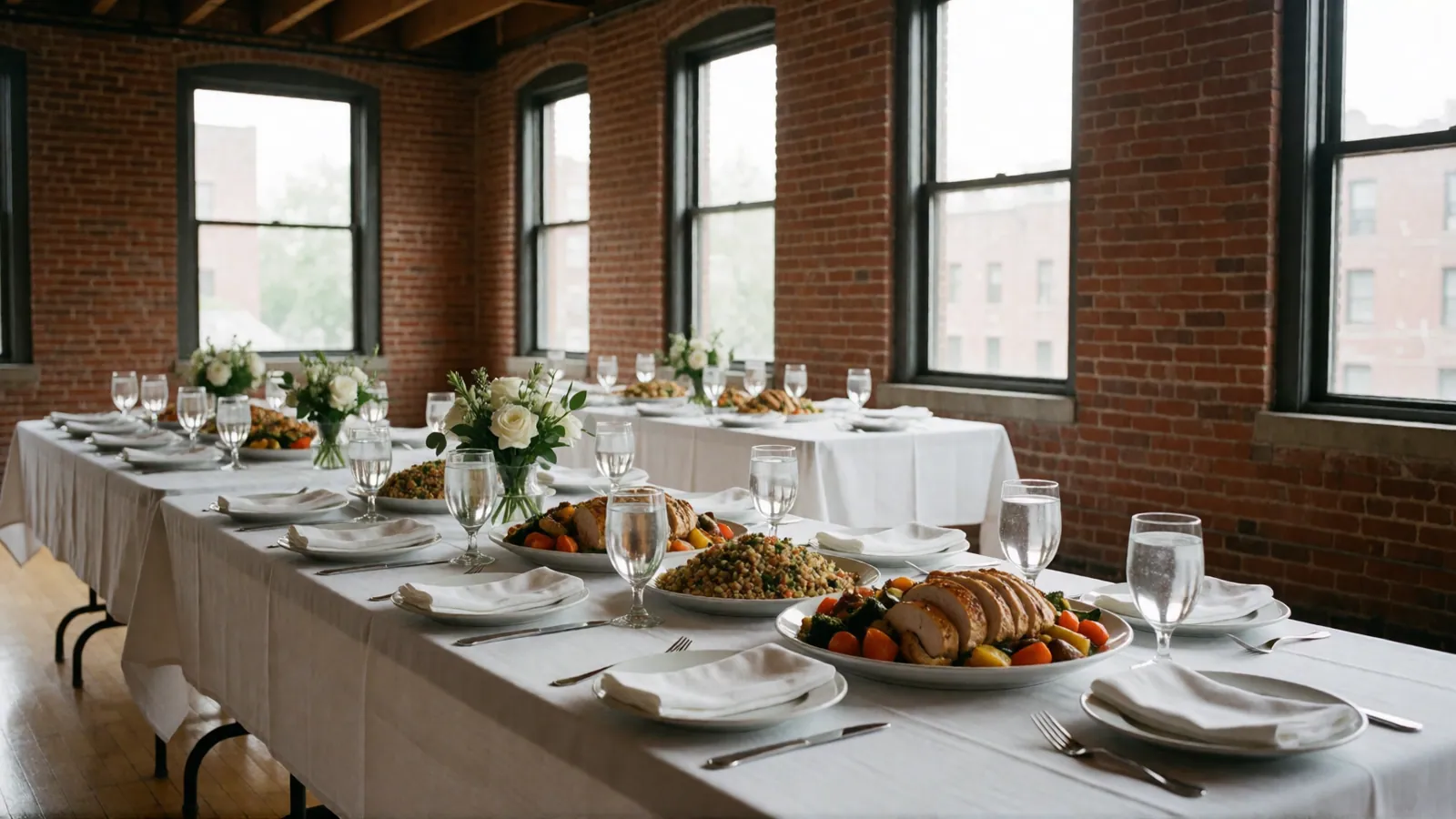
AI-generated illustration. Not a real dish, kitchen or event.
Planned with you, and with the venue
Most of the work on a wedding dinner happens before anybody cooks it.
Callum Ferreira-Santos, our events manager, plans every wedding with the couple and with the venue, and on the day he runs it. Callum visits a venue before he quotes for it, to see its kitchen, its doors and its rules about flame.
Those three things shape the estimate as much as the menu does: whether there is a kitchen to finish the hot food in, how far every tray travels from the loading door to the room, and whether anything may be kept warm over a flame.
Then you choose how dinner is served. A buffet, platters set down the middle of each table, three plated courses or food stations: the food can be much the same, but each style takes a different number of people to serve it, and that is where the estimates part company.
- Every wedding starts with an enquiry and a written estimate.
- We don't run the bar: your venue or a licensed bar service does.
What happens on the day
From the van at the loading door to the last tray packed away.
The team arrives and sets up
The team arrives two hours before guests for a buffet or a reception, three for a plated dinner, and leaves once the food is cleared and the venue's kitchen is as it was found. Their hours run from arrival to clearing, which is why nobody is booked for less than five hours. Rafael Okafor-Medina runs the hot line. On an event day he is the one cooking at the venue's kitchen while the rest of the team serves.
The room is ready before the guests are
The buffet, the stations or the places at each table are laid before the first guest arrives. At staffed events we use chafing fuel only where your venue allows open flame. Where a venue allows no open flame, hot food is held in insulated carriers and electric warmers plugged in at the venue, and served from them.
Dinner goes out
At a buffet the servers stand behind the line and keep every dish full; family-style, they set platters on each table and come back with more; plated, three courses go out table by table. What each takes: staffed buffet: one server for every twenty-five guests; family-style dinner: one server for every fifteen guests; plated three-course dinner: one server for every ten guests; and food stations: one server for every twenty guests.
The captain runs the floor
On the day Callum is the captain: the person the host talks to and the staff answer to. If the speeches run long, the captain is the one who tells the kitchen to wait with the main course, so it goes out hot rather than early.
Clearing away
When dinner is over, the staff clear what they served and pack what we brought. That time is inside their booked hours, not a line of its own.
Four ways to serve the same dinner
Guide prices for the food, as ranges, with the servers each style takes.
| Style | Food a guest | Servers |
|---|---|---|
| Staffed buffet | $45 to $65 a guest | One server for every twenty-five guests |
| Family-style dinner | $60 to $80 a guest | One server for every fifteen guests |
| Plated three-course dinner | $75 to $110 a guest | One server for every ten guests |
| Food stations | $60 to $90 a guest | One server for every twenty guests |
A buffet takes the fewest servers and lets guests choose; it also asks everyone to stand in a line. Family-style puts the food on the table and gets people passing dishes to each other. Plated is the most formal and takes the most people, because every course is carried to every guest. Stations sit between the two: a chef or attendant at each one, and guests moving around the room.
The longer comparison of the three dinner styles goes through which suits which room.
Guide figures, not a quote. These are guide figures for the food, as ranges, because an event's menu is chosen with you; your estimate will price every dish and every hour on its own line, before sales tax, which is charged on staff hours as on the food. A chef or station attendant, where the style needs one, is on the estimate at that rate too.
A worked example
A guide range computed from the same figures the table prints.
A buffet wedding dinner for a hundred and twenty Staffed buffet
- Food, as a guide$45 to $65 a guest$5,400.00 to $7,800.00
- Stafffive servers and one captain for six hours$1,830.00
- Guide rangebefore sales tax$7,230.00 to $9,630.00
These are guide figures for the food, as ranges, because an event's menu is chosen with you; your estimate will price every dish and every hour on its own line, before sales tax, which is charged on staff hours as on the food. A chef or station attendant, where the style needs one, is on the estimate at that rate too.
This is a buffet wedding dinner for a hundred and twenty: the food at the guide price a guest, both ends, and five servers and one captain for six hours at the hourly rates below.
An estimate comes back within two business days of an enquiry, itemized: every dish, every hour of every person, and the tax. A tasting for a wedding is set at the kitchen with the events manager, for the two of you, once the estimate suits you; it is on the estimate as its own line, and it is taken off the final bill if you go ahead.
The final guest count is due ten days before the event, fourteen for a wedding; the agreement prices that count.
Who works it, and what an hour costs
Every person on the day is billed by the hour, on a line of their own.
| Who | An hour |
|---|---|
| Server | $48 an hour |
| Chef or station attendant | $70 an hour |
| Event captain | $65 an hour |
How staff are booked. Staff are booked for at least five hours each, setting up and clearing away included; every staffed event has at least two servers and one captain. Staff hours are taxed like the food.
Staff hours are wages. Staff hours pay for the time of the people who work your event. They are not a tip or gratuity, and they are not paid out to staff as tips. We never add a service charge or an automatic gratuity. Tipping is up to you, and any tip goes in full to the staff who worked your event.
Tipping is up to you, and any tip goes in full to the staff who worked your event.
Linens, plates, glassware and chafing dishes for a staffed event are rented from a rental company and passed on at cost on the estimate; nothing is marked up.
The bar, the flame and the venue
Three things a wedding caterer is often asked to promise, and what we say instead.
No bar. We don't supply, sell or serve alcohol, and our staff don't pour it, even when it's your own. If you'd like a bar, your venue or a licensed bar service can run it, and we'll work around them.
Hot, without a flame. Drop-off orders arrive hot in insulated carriers, ready to serve. We don't send fuel cans or burners. At staffed events we use chafing fuel only where your venue allows open flame.
Private events only. We cater private events: offices, homes and venues you've booked. Your venue holds its own permits; we're happy to tell you what to ask them. We don't cater street fairs, festivals or events open to the public.
Whoever runs the bar works alongside our staff on the night: we plan the room with them, and they pour. Ask your venue first, because many halls run their own.
Tell us about the wedding
The date, the venue, the number of guests and how you'd like dinner served. We'll reply with an estimate that prices every line.