The journal
How long can catered food sit out?
Two hours, one in the heat, and why the kitchen's clock and yours are different clocks.
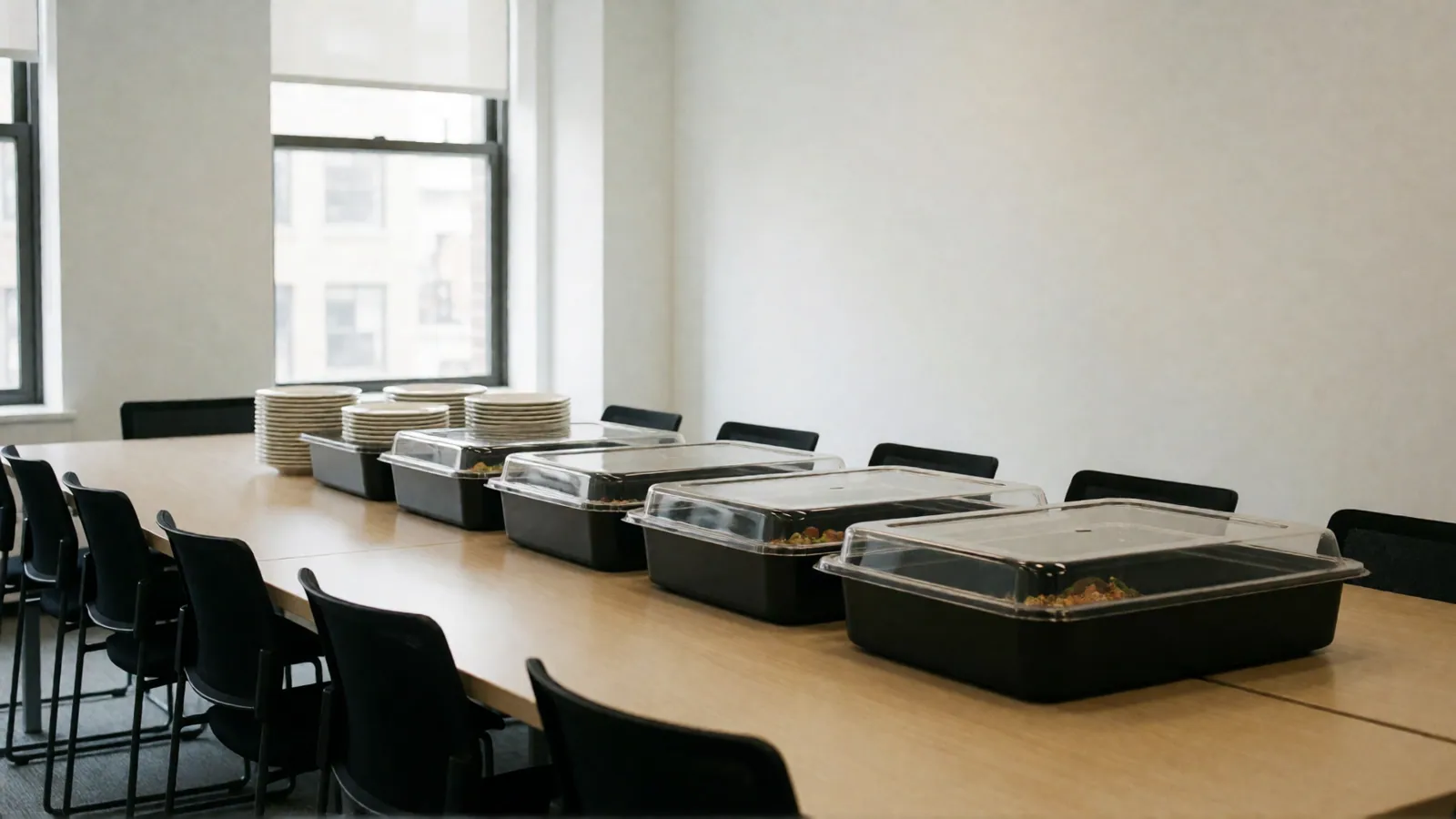
AI-generated illustration. Not a real dish, kitchen or event.
The short answer is two hours from the moment it arrives, and one hour if it is outdoors in hot weather. The longer answer is about whose clock is running, because the kitchen's clock and yours are different clocks.
Two hours once it arrives. Hot food leaves our kitchen hot and cold food leaves it cold. Once it's with you, please serve it within two hours (one hour outdoors in hot weather) and refrigerate anything left over.
The kitchen's clock
Inside a kitchen, the rules below decide how food is held: hot above one temperature or cold below another, and out of both only for a limited time, under a label saying when to throw it out, and never on a buffet. That clock is kept with thermometers and records, by people whose job it is to keep them. It runs while the food is cooked, packed and driven, in insulated carriers that hold the heat or the cold. It stops when the trays are set down on your table.
- N.Y.C. Health Code § 81.09 (opens the source in a new tab) Food that can spoil is held at or below 41°F or at or above 140°F.
- N.Y.C. Health Code § 81.10 (opens the source in a new tab) A kitchen may hold food out of temperature only for a limited time, labeled with when to discard it, and never on a buffet.
Your clock
From then on the food is in a room the kitchen cannot see: warm or cool, sunny or not, with the lids on or off. Nobody is taking its temperature. The advice for food in that situation is the advice for food left out at home: a limit simple enough to keep without a thermometer, and shorter in the heat, because warm food left standing is where the trouble starts.
That is why every tray here leaves labeled with the time it left the kitchen, and why we never say a tray stays good for longer than two hours after it arrives.
Making the time work
Choosing a window. You choose a delivery window: half an hour in Queens and Greenpoint, an hour in Midtown Manhattan. Book it to end about thirty minutes before you want to eat, so there's time to set the trays out.
- Book the window to end shortly before the meal, so the time is spent eating rather than waiting.
- Leave the lids on until people are ready to eat, and set the trays out in the order they will be eaten.
- Keep cold dishes away from a sunny window or a radiator.
- Don't add food from a new tray to one that has been out; put the new tray beside it.
- Ask one person to keep an eye on the time, using the label.
- Outdoors in hot weather, keep the trays in the shade and keep to the shorter time.
Leftovers
Refrigerate leftovers, covered, inside the time. Anything that has been out longer goes in the trash, however good it looks; there is no way to tell by looking. A hot dish that is kept should be reheated until it is steaming all the way through before anybody eats it again.
What does not come with the trays
There is no flame under a drop-off tray to stretch the time, and nothing raw on the drop-off menu.
Hot, without a flame. Drop-off orders arrive hot in insulated carriers, ready to serve. We don't send fuel cans or burners. At staffed events we use chafing fuel only where your venue allows open flame.
Cooked through. Nothing on the drop-off menu is raw or undercooked: no sushi, no oysters, no runny eggs.
Order a drop-off, or plan an event
Order a drop-off for ten to sixty guests by noon on the kitchen day before, or tell us about an event and we'll write you an estimate.