The journal
How to tell a caterer about an allergy
What "made without" means in a shared kitchen, why a caterer that promises "nut-free" is promising something it can't see, and the call to expect.
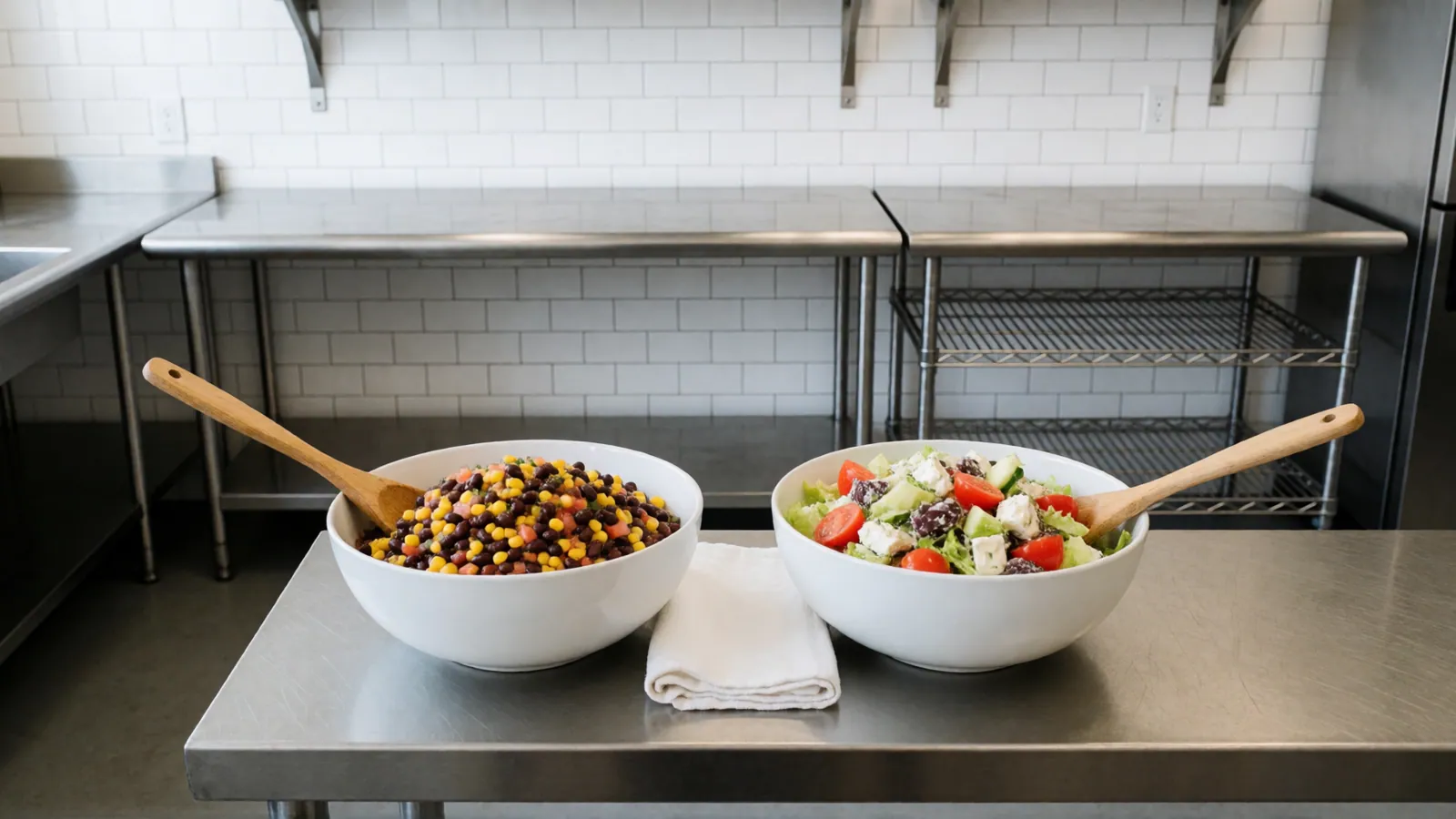
AI-generated illustration. Not a real dish, kitchen or event.
An allergy at a catered lunch passes through three people who rarely speak to each other: the guest, the person placing the order, and the kitchen. Most of what goes wrong happens in the gaps between them, and most of it is closed by a few plain questions asked in the right order.
Start with the guest
Ask which allergen, and how careful they need to be. Some people avoid an ingredient; some react to a trace of it on a shared spoon; only they know which, and the answer changes what you order.
Ask whether they would rather have a box of their own, with their name on it, than take from a shared platter. And ask whether there is anything they always bring with them. You do not need that answer for the order, but they will notice that somebody asked.
What a menu can tell you, and what it cannot
Every dish on this menu lists which of the nine major food allergens its recipe contains: milk, eggs, fish, crustacean shellfish, tree nuts, peanuts, wheat, soybeans and sesame. That is a fact about the recipe, written down by the people who cook it, and it is printed on the tray as well as on the page.
What "made without" means. What we tell you is what a recipe contains. A dish made without wheat is a dish whose recipe has no wheat in it; it is not a dish that is free of wheat, because it was made in a kitchen where wheat is used every day.
That is why a caterer that prints "nut-free" on a lunch is promising something it cannot see. It knows what it put into the recipe; it cannot know what was on the board, the spoon or the shelf before the dish was made. The person who bakes here keeps the line in plain words:
Pemba Lhamo Garrity, morning and pastry lead
Pemba keeps the nut-containing bought-in goods on their own shelf and their own trays, and still won't call anything nut-free.
What a box does, and what it does not
A boxed lunch helps in one practical way. Each box is packed for one guest, with their name, its contents and the allergens in its recipe on the label, so their lunch never sits on a shared platter where tongs move from tray to tray.
It does not change the kitchen it was made in, and it is not a promise. It is one fewer place for a mistake to happen, which for a careful guest is worth having.
Putting it on the order
On this site, an allergy goes on the order form: tick each of the major allergens that applies, add a line about anything else, and send the order.
If you have a food allergy or intolerance, please notify us. Tell us about an allergy on the order form and the kitchen telephones you before your food is made, to go through every dish on the order.
Nusrat Haque-Delaney, catering coordinator
Every order with an allergy on it gets a call from her before the kitchen starts it.
Have the guest's answers in front of you when the telephone rings: which allergen, how careful, and whether they want a box. The call goes through every dish on the order, so it is also the moment to swap one.
If the allergy is severe, call before you order rather than after. The note below is the kitchen's own sentence on it, and it is the same on every page that mentions food:
One kitchen, nine allergens. Our kitchen handles all nine major food allergens (milk, eggs, fish, crustacean shellfish, tree nuts, peanuts, wheat, soybeans and sesame) on shared equipment. We list what's in every dish and label every tray, but we can't promise any dish is free of an allergen, and we don't make gluten-free, nut-free, kosher, halal or organic food. For a severe allergy, please call us before you order.
On the day
Serve the guest with the allergy first, before spoons have moved between trays. Keep each tray's own spoon in it. Read the label on every tray, and if something arrives that you did not order, do not guess: telephone.
Every tray, labeled. Every tray leaves the kitchen labeled with the dish, how many guests it serves, the allergens in its recipe, and the time it left.
The two State rules behind it
- N.Y. Public Health Law § 1356 (opens the source in a new tab) A menu, including one online for ordering, carries the sentence "If you have a food allergy or intolerance, please notify us.", and an online order menu gives the customer a way to say so.
- N.Y. Public Health Law § 1357 (opens the source in a new tab) From November 12, 2026, food packed in advance for sale on the same premises is labeled with any major allergen in it.
The first is why the sentence about allergies appears on every menu page here and on the order form, with a way to answer it. The second is about labels on food packed in advance; every tray here is labeled whatever a rule asks, because the label is how the list on the website reaches the table.
Order a drop-off, or plan an event
Order a drop-off for ten to sixty guests by noon on the kitchen day before, or tell us about an event and we'll write you an estimate.